How many fish are on the menu in a sushi restaurant in Tokyo?

In sushi restaurants in Tokyo there are approx. 15 different kinds of fish on the menu.

The Japanese people eat just as much fish in everyday life as we eat meat. When the Japanese visit a sushi restaurant in Tokyo, they want to taste as many different fish as possible.

The type of sushi that is most popular in Tokyo is nigiri sushi. Nigiri sushi is of a size that you as a guest can eat 10-15 pieces of sushi without feeling stuffed. Eating nigiri in Tokyo is an exciting experience. You get to taste many different fish that are not found in our latitudes.

In Europe we eat a little less fish. Most people eat fish 1-2 times a week. For one thing, sushi is one of the ways to get the recommended 350 gram of fish a week.

In Europe, sushi rolls are just as popular as nigiri sushi is in Japan. The selection is large, it is possible to taste several different rolls during a meal.

Read more about Sushi course for beginners

_
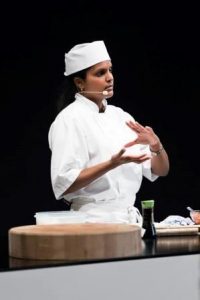
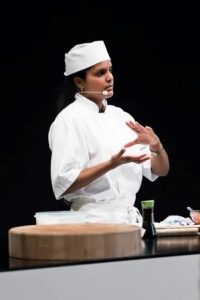
Zoë has lectured and held sushi courses for A. P. Moller – Maersk, Hugo Boss Nordic, Novo Nordisk, Novartis, Velux, Gorrissen Federspiel, Beierholm revision, Elbek & Vejrup and many more.
What kind of sushi is most popular in Denmark?

Sushi roll futomaki with prawns, web: http://chefzoeescher.com

In Europe, there is a kind of sushi, which is most popular among all the styles.

It is sushi rolls. If you visit a sushi restaurant in Europe, there are typically 15-20 different rolls with different ingredients and topping. In a European sushi restaurant, there are usually several small sushi rolls on the menu. Sushi rolls insite-out which means that the rice is outside the roll with the topping available in many different versions and flavors.

The large roll futomaki is also popular. It is a roll that can be difficult to take a bite due to its size. It is also a roll where there is room for a lot of filling.

In Japan, nigiri sushi is the most popular of them all. In the exclusive sushi restaurants, there are typically 15-20 different fish on the menu. The Japanese people eat a lot of fish every single day that is way they prefer to eat nigiri pieces.

At the exclusive restaurants, a meal ends with a small sushi roll.

Read more about Sushi course for beginners

_
Zoë has lectured and held sushi courses for A. P. Moller – Maersk, Hugo Boss Nordic, Novo Nordisk, Novartis, Velux, Gorrissen Federspiel, Beierholm revision, Elbek & Vejrup and many more.

What is meant by “clean cut” in Japanese gastronomy?

Japanese cuisine differs from other cuisines in the world in that the food is very “clean”.
This applies from everyday food to fine dining.

In Japanese cuisine, the ingredients are prepared as little as possible.
To highlight the unique flavors and aromas of the ingredients, the way you use the knife is crucial to how tasty the dish ends up being.
This means that there are other requirements for the way you use your knife. In Japan, your knife can be used in many thousands of different ways; it is the raw materials in question that determine which technique to use.

The fewer raw materials used in a dish, the more important it is that knife techniques are used, made as “clean” as possible, i.e. do not make notches or marks in the raw materials in order to get the full benefit of the raw materials.

At Sushi course for beginners, you will be introduced to the most commonly used Japanese knife techniques.

_
Zoë has lectured and held sushi courses for A. P. Moller – Maersk, Hugo Boss Nordic, Novo Nordisk, Novartis, Velux, Gorrissen Federspiel, Beierholm revision, Elbek & Vejrup and many more.

Is there a big difference in the quality of fish?

Yes it is there.

There is a big difference in quality compared to whether it is a fish that you have to cook or whether it is a fish that is to be used for sushi.

Does it matter?

No, it’s not.

One of the criteria is that a fish must be as fresh as possible. If the fish is not fresh enough then you can risk getting sick.

In addition, it is also important where the fish has grown up. There are some areas in the world’s oceans that have just the right conditions in terms of the quality demanded for sushi.

At the Sushi course for beginners, you will learn what questions to ask a fishmonger when buying fish for sushi

_
Zoë has lectured and held sushi courses for A. P. Moller – Maersk, Hugo Boss Nordic, Novo Nordisk, Novartis, Velux, Gorrissen Federspiel, Beierholm revision, Elbek & Vejrup and many more.

Does it require a special knife if you want to learn how to make sushi?

In a sushi course for beginners, you will learn how to make delicious and tasty sushi that is suitable for a nice dinner at home.

In the class you will learn to apply Japanese cutting techniques at beginner level. To get the most success with the techniques required, you need to have a very sharp knife. The size of the knife or the brand is not crucial at that level.

If you want to make sushi that is suitable for a restaurant then you need to have a special knife and focus your skills.

You can read more about Sushi course for beginners

_
Zoë has lectured and held sushi courses for A. P. Moller – Maersk, Hugo Boss Nordic, Novo Nordisk, Novartis, Velux, Gorrissen Federspiel, Beierholm revision, Elbek & Vejrup and many more.

Can all types of sushi mats be used to make sushi?

Unfortunately not.

The selection of sushi mats is large in Denmark. There are many different types ranging from silicone mats to Japanese sushi mats and not all of them are suitable for sushi.

Kitchen utensils made of silicone are popular and the selection is getting bigger and bigger. Within the last few years, more and more kitchenware shops have started selling sushi mats made of silicone.

Occasionally, I meet attendances who show up on my sushi class with a silicone mat under the arm for which they have paid DKK 250-300. Unfortunately, I will have to disappoint them every time.
Silicone mats are definitely unsuitable for sushi even though they are easy to clean. Silicone is a very smooth material it is very difficult to make nice sushi rolls. In addition, they do not have the same flexibility as sushi mats made of wood. It also makes it difficult to make nice and firm rolls.

At the Sushi course for beginners I tell you more about the type of sushi-eating Japanese sushi chefs. It is a sushi mat that I also sell in my web shop.

_
Zoë has held sushi courses and cooking classes for A. P. Moller – Maersk, Hugo Boss Nordic, Novo Nordisk, Novartis, Velux, Gorrissen Federspiel, Beierholm revision, Elbek & Vejrup and many more.

Do fishmongers know what type of fish is suitable for sushi?

All fishmongers know what kind of fish is used for sushi.

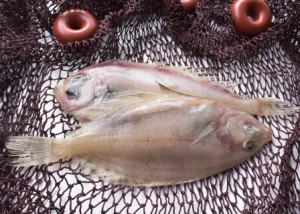
It is very important to ask for fish for sushi. Fish for sushi has a completely different quality than fish to be fried.

The reason for the difference in quality of fish is that fish for sushi being eaten raw. It is very important to use top quality fish. If you eat raw fish that has become too old you may become ill.

At Sushi course for beginners I talk more about what kind of fish to buy for sushi

_
Zoë has held sushi courses and cooking classes for A. P. Moller – Maersk, Hugo Boss Nordic, Novo Nordisk, Novartis, Velux, Gorrissen Federspiel, Beierholm revision, Elbek & Vejrup and many more.