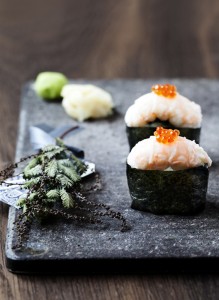
What raw materials do Japanese sushi chefs prefer to use for sushi?

In Tokyo, the Japanese have a slightly different approach to sushi.

Most Japanese prefer to eat nigiri rather than sushi rolls.

If you are dining at a sushi restaurant in Tokyo the rolls will often contain something different from what we know about in Europe. In Japan, it is very normal to serve a hosomaki (small roll) to end a sushi meal.

It may contain pickled plum or tuna.

When it comes to sushi there is nothing right or wrong. Most restaurants have their own style. When it comes to raw materials Japanese sushi chefs in Tokyo and I are in favor of using local produce that is in season.

Read more about the Sushi course for beginners

_
Zoë has held sushi courses and cooking classes for A. P. Moller – Maersk, Hugo Boss Nordic, Novo Nordisk, Novartis, Velux, Gorrissen Federspiel, Beierholm revision, Elbek & Vejrup and many more.

Can all types of vinegar be used for sushi?

Not all types of vinegar are suitable for sushi.

There are many different kinds of vinegar in Denmark. There are some vinegar made in Denmark, others in Thailand, China or Japan.

It is always best to use Japanese vinegar for sushi and there are several reasons for that.

Japanese vinegar is made of rice grains. Since the Japanese vinegar is made on rice, the sour / sweet vinegar flavor suits the sushi rice.
If the vinegar were made on, for example apple the rice vinegar would have a completely different taste.

Rice vinegar is also used to preserve sushi rice so it can be kept at room temperature. Beside that, vinegar is also used as a kind of spice.

The aromas and fine flavors found in Japanese rice vinegar help to give the sushi rice the unique taste that characterizes Japanese sushi rice.

Read more about Sushi course for beginners

_
Zoë has lectured and held sushi courses for A. P. Moller – Maersk, Hugo Boss Nordic, Novo Nordisk, Novartis, Velux, Gorrissen Federspiel, Accenture audit Elbek & Vejrup and many more.

What is the purpose of wasabi?

Most people have experienced wasabi when they eat sushi.
There are many in Europe who uses wasabi to give their sushi a little extra flavor. It often happens that guests mix wasabi with soy sauce and then dip a piece of sushi into the mixture.

Japanese sushi chefs use wasabi in another way.
In Japan, the guests do not have the opportunity to taste their sushi with wasabi. The only guests get handed when they sit at the table are pickled ginger and soy sauce.

In Japan, wasabi is not used for all sushi there are some seafood that tastes better without wasabi. The Japanese sushi chefs use wasabi to highlight flavors in the particular piece of sushi. It may vary depending on what other taste is involved in the preparation of that piece of sushi.

Read more about Sushi course for beginners

_
Zoë has held sushi courses and cooking classes for A. P. Moller – Maersk, Hugo Boss Nordic, Novo Nordisk, Novartis, Velux, Gorrissen Federspiel, Beierholm revision, Elbek & Vejrup and many more.

What is Japanese chef’s view of fish?


Japanese chefs have a different view of fish.

In Japan, Japanese chefs use only raw materials that are in season.

A Japanese fish named Katsuo which is in the family with the tuna is in season 2 times a year. In spring it swims from southern Japan to the north. In spring, it is low in fat whereas in autumn when caught in northern Japan it is fat. On its swim from south to north it has eaten many small fish.

As a restaurant guest you can only find it on the menu card for a few months a year.
This is something that restaurant guests enjoy since the menu of Japanese restaurants in Tokyo changes very often.

Read more about the class Traditional Japanese cooking class for beginners.

_
Zoë has lectured and held sushi courses for A. P. Moller – Maersk, Hugo Boss Nordic, Novo Nordisk, Novartis, Velux, Gorrissen Federspiel, Beierholm revision, Elbek & Vejrup and many more.
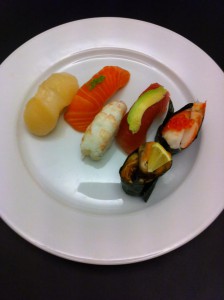
Fish for sushi must be of the best quality and why?

There are many people who do not fully realize that there is a difference in the quality of fish. For sushi, only the best quality fish should be used and there is a reason for that.

Sushi is a nice and delicate dish and you must have knowledge on how to use very high quality fish so you can turn a simple looking piece of nigiri to a gastronomic experience.

The quality of the fish is also assessed on the basis of when the fish is caught. The fish must be as fresh as possible and it should preferably only be a few hours old. Then the bacterium in the fish has not begun to develop.

At the Sushi course for beginners I talk more about fish for sushi

_
Zoë has lectured and held sushi courses for A. P. Moller – Maersk, Hugo Boss Nordic, Novo Nordisk, Novartis, Velux, Gorrissen Federspiel, Beierholm revision, Elbek & Vejrup and many more.
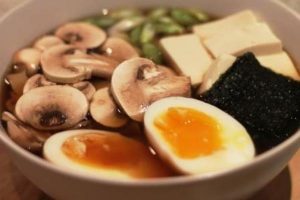
Ramen noodle soup can be eaten all year in Japan!

In Japan, the ramen noodle soup is not only eaten in winter. It is a dish enjoyed all year long and there are several reasons for that.

Ramen noodle soup is a healthy and tasty fast food to suit the busy day of Japan. It is also a dish that does not take many minutes and makes once you have made the fish stock that forms the whole foundation of the Japanese kitchen. Yes without it there is no Japanese kitchen.

On noodle soup course for beginners the attendants learn to make 2 very different tasty noodle soups. Noodle soups where authentic raw materials from Tokyo are used in the preparation of soups.

You can read more about Noodle soup courses for beginners

_
Zoë has held sushi courses and cooking classes for A. P. Moller – Maersk, Hugo Boss Nordic, Novo Nordisk, Novartis, Velux, Gorrissen Federspiel, Beierholm revision, Elbek & Vejrup and many more.
What soy sauce do exclusive sushi restaurants in Tokyo use?


Exclusive Japanese sushi restaurants in Tokyo differ from other restaurants. In Europe many people use Michelin guide as a yardstick which is not the case in Japan.

In Japan, many exceptional restaurants never be published in the Michelin Guide. These gourmet sushi resturant use af different type and unique soy sauce.

The restaurant will often use a homemade soy sauce where the recipe is secret. It may be a soy sauce developed by the sushi chefs but it can also be a recipe that has been passed down through generations. It is different from restaurant to restaurant.

Read more about the Sushi course for beginners

_
Zoë has held sushi courses and cooking classes for A. P. Moller – Maersk, Hugo Boss Nordic, Novo Nordisk, Novartis, Velux, Gorrissen Federspiel, Beierholm revision, Elbek & Vejrup and many more.
Memory: Elite kendo training in Tokyo, 2004

Practice with the national team coach of the Japanese kendo women’s team in kendo at Tokyo University in Tokyo in 2004.

I’ll never forget that??❤️.

Read more about Sushi chef & sake sommelier Zoë Escher

_
Zoë has held sushi courses and cooking classes for A. P. Moller – Maersk, Hugo Boss Nordic, Novo Nordisk, Novartis, Velux, Gorrissen Federspiel, Beierholm revision, Elbek & Vejrup and many more.

Does the weather affect the preparation of sushi?

The weather greatly affects the preparation of sushi. Right from handling og sushi rice, preparing ingredients and making sushi with your hands.

Japanese sushi is a dish that focuses on individual ingredients. I know well that in a lot of countries many different ingredients are used in most sushi restaurants. If you look at authentic Japanese sushi there are quite a few ingredients included.

When the food becomes so simple your “mistake” is easily shown since you cannot hide anything, including the weather.

It is one of the reasons it takes Japanese sushi chefs many years to cook sushi rice to perfection which is a must if you work in a sushi restaurant.

On the Sushi course for beginners the attendances will learn what it takes to cook sushi rice to perfection.

_
Zoë has held sushi courses and cooking classes for A. P. Moller – Maersk, Hugo Boss Nordic, Novo Nordisk, Novartis, Velux, Gorrissen Federspiel, Beierholm revision, Elbek & Vejrup and many more.

Is it best to use Japanese sushi rice?

There are many countries that produce rice for sushi such as Japan, the United States, Korea, Italy, and Thailand.

Using Japanese-produced sushi rice is not a must. In Japan, there are many different types of sushi rice of different grades. Japanese sushi rice is not always the best choice if you are not used to cooking sushi rice.

Some Japanese rice varieties are harder to cook than others, so buying Japanese sushi rice is not always an advantage.

On the Sushi course for beginners I talk more about which rice is best for Sushi.

_
Zoë has held sushi courses and cooking classes for A. P. Moller – Maersk, Hugo Boss Nordic, Novo Nordisk, Novartis, Velux, Gorrissen Federspiel, Beierholm revision, Elbek & Vejrup and many more.